
VESA DSC, or Display Stream Compression, has become an important lightweight compression technology in high-resolution display systems. It is widely used with DisplayPort, eDP, MIPI DSI, HDMI, and other display interfaces to reduce link bandwidth while maintaining visually lossless quality and very low latency.
In FPGA projects, however, engineering teams often face a practical challenge: DSC encoding can consume significant logic, and timing closure is not always straightforward. Here, “resource-intensive” refers not only to IP licensing, but also to the logic, design complexity, timing pressure, and potential device cost required for real-time encoding or decoding.
This is especially important in multi-display, high-resolution, high-refresh-rate, and resource-constrained designs. A full codec chain can increase both implementation cost and project risk. Rather than repeating the DSC standard or a complete IP specification, this article addresses three engineering questions:
- Why does DSC tend to be resource-intensive on FPGA?
- When can full real-time DSC encoding or decoding be avoided?
- Which system-level choices can reduce FPGA resource cost and implementation risk?
1. Why DSC Can Be Expensive on FPGA
1. The Encoder Contains Multiple Candidate Processing Paths
A DSC encoder is not a simple pixel pipeline. It must support mechanisms such as MMAP, or Modified Median-Adaptive Prediction, MPP, or Midpoint Prediction, optional BP, or Block Prediction, and ICH, or Indexed Color History. It also performs prediction, residual calculation, quantization, reconstruction, mode decision, and rate control in real time.
These paths are not fully independent. Their enable conditions, selection logic, reconstructed values, and rate-control states interact, giving the encoder more complex control and data dependencies than the decoder.
In an ASIC, this fine-grained combinational logic can often be balanced through standard-cell mapping and customized physical implementation. On FPGA, the same logic must map onto LUTs, flip-flops, BRAMs, and programmable routing resources. Fine-grained dependencies and wide datapaths therefore add logic utilization and routing pressure.
2. Timing-Closure Pressure Comes from Local Feedback Chains
Public VESA material describes how DSC modifies traditional prediction structures to support a higher degree of parallel prediction for consecutive sample values. In hardware, however, supporting parallel prediction does not mean the entire encoding path can be fully parallelized.
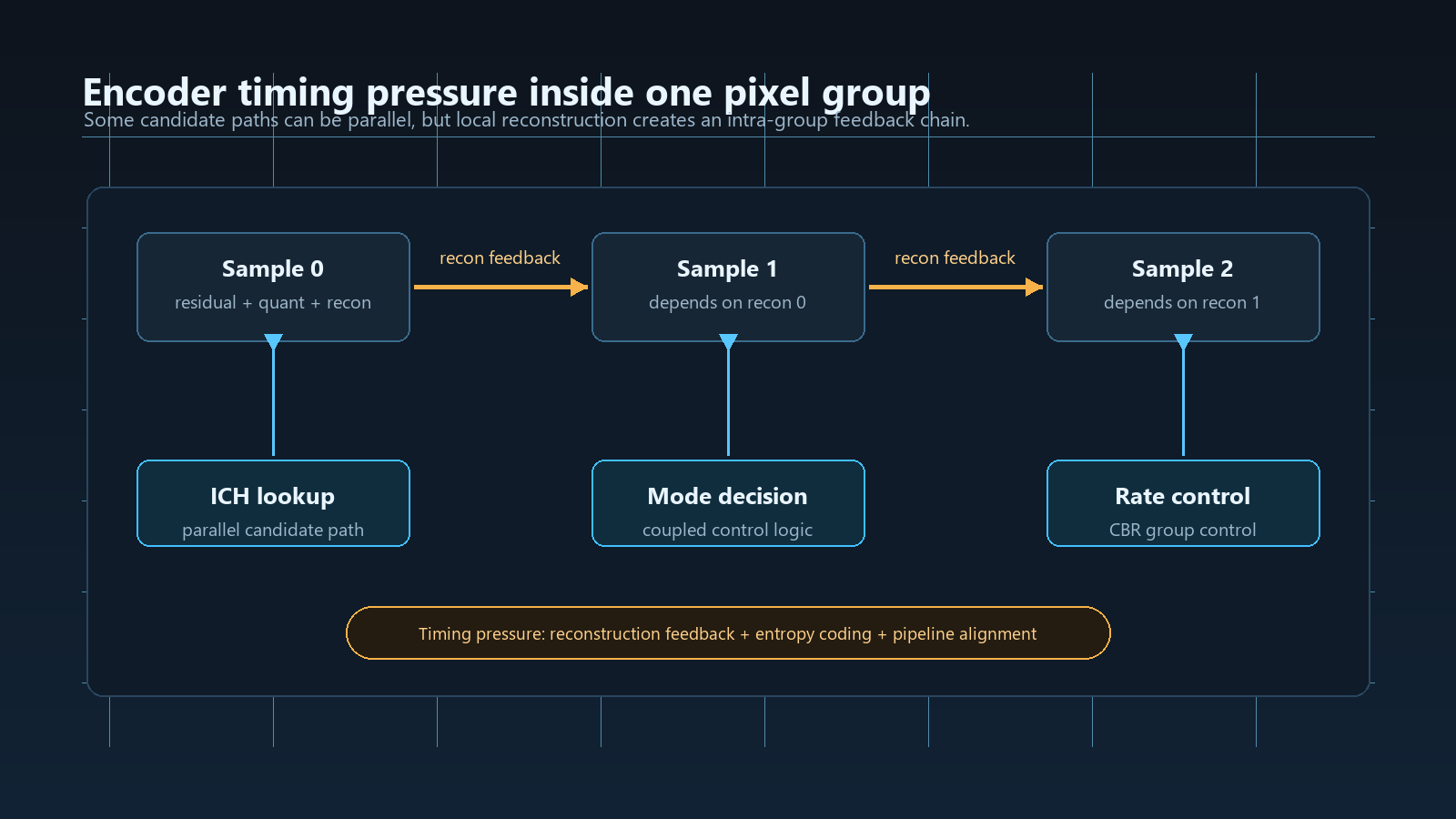
Within a pixel group, candidate paths such as ICH can perform lookup and decision logic for multiple samples in parallel. Residual calculation, quantization, inverse quantization, and local reconstruction still introduce intra-group feedback: a later sample depends on the locally reconstructed value produced for an earlier sample.
Combined with entropy coding, rate control, and multi-stage pipeline alignment, this local chain can create substantial combinational and routing pressure. The main challenge is often not a single algorithm block, but the way multiple stages are coupled under a continuous pixel-stream schedule.
3. Encoder and Decoder Complexity Is Asymmetric
A DSC decoder still performs prediction, inverse quantization, and reconstruction. When BP is enabled, it also needs the corresponding Block Prediction search path. However, it does not perform encoder-side mode decisions, rate-control decisions, or compressed-bitstream generation.
The decoder control path is therefore more regular in many FPGA designs and often easier to pipeline or parallelize. In practice, the encoder is usually the side with greater resource pressure and timing-closure risk, making this asymmetry an important starting point for system-level optimization.
2. Four System-Level Optimization Methods
Method 1: Content Pre-Encoding — Use Offline Pre-Encoding for Fixed Test Content
For panel production tests, module tests, and aging testsIn these systems, an FPGA often acts as a video signal generator that outputs fixed test images or videos. If the content is known in advance, a real-time DSC encoder may not be needed inside the FPGA.
A lighter architecture pre-encodes the content on a PC or server and stores the compressed DSC bitstream in DDR, Flash, or another external memory. The FPGA only reads the stream, manages timing, packetizes the data, and transmits it through MIPI DSI, DisplayPort, or another interface.
This can turn a real-time encoding task that requires a large device into a much lighter datapath and interface-control problem. The limitation is equally clear: offline pre-encoding works only when content is fixed or predictable. Systems with real-time overlays, rendering, or dynamically generated content need a carefully evaluated pre-encoded library or a real-time encoder.
Method 2: Slice-Domain Routing — Compressed-Stream Routing and Repackaging at Slice Boundaries
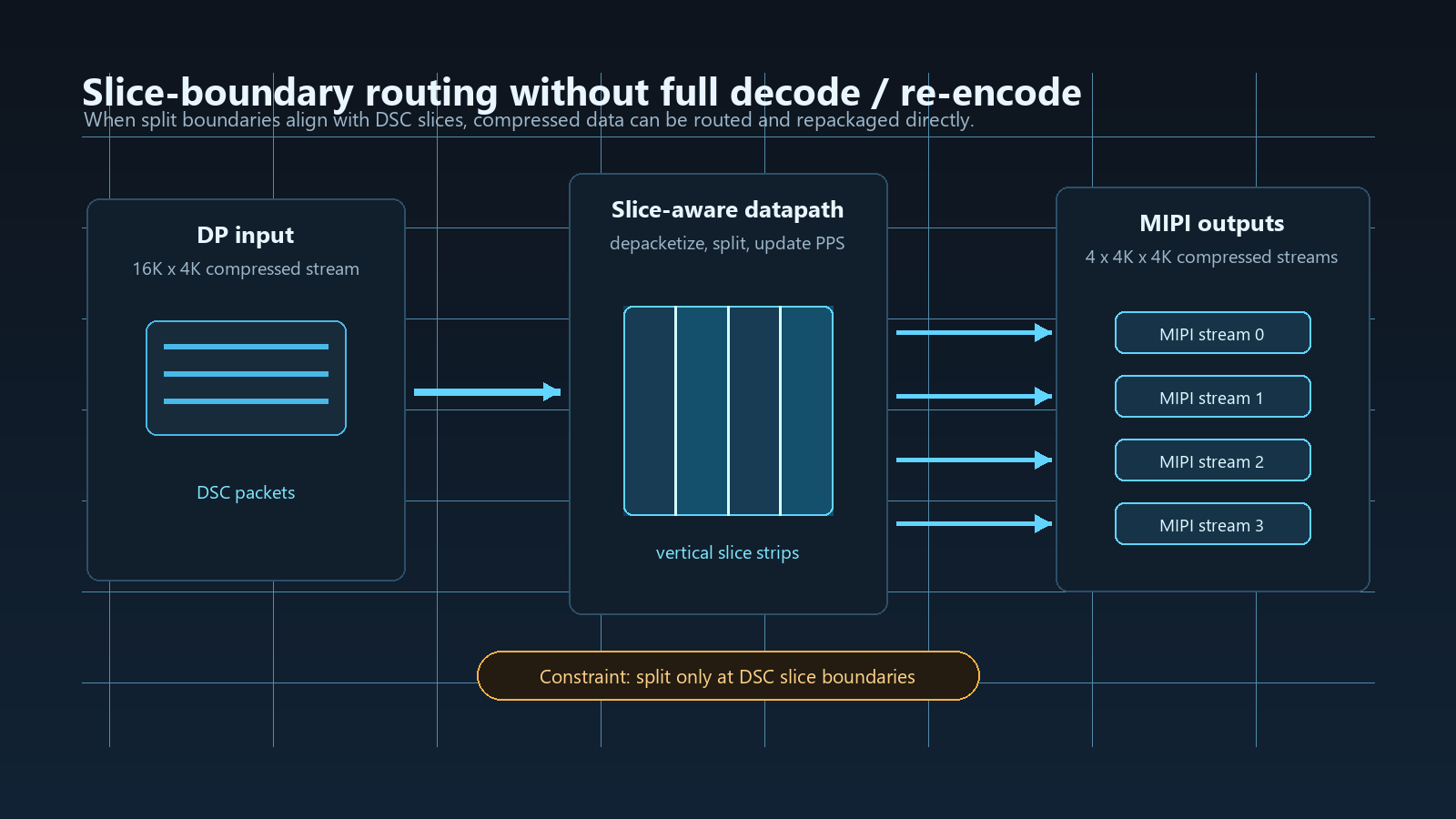
For AR/VR, high-resolution display bridges, and multi-panel splittingConsider a very wide DSC-compressed image received over DisplayPort that must be split into vertical strips and sent through multiple MIPI DSI links. The straightforward approach fully decodes the input and re-encodes each output, requiring one decoder plus multiple encoders.
If the system configuration allows it, the independent nature of DSC Slices enables compressed-domain processing. The source divides the image into vertical strips, each containing one or more standard Slices. The receiving FPGA then depacketizes, routes, updates PPS or interface fields, and repacketizes at Slice boundaries without changing the compressed data inside each Slice.
This changes the problem from multi-channel decoding and re-encoding into compressed-stream routing and packet repackaging.
This method has strict prerequisites:
- The split must align with DSC Slice boundaries, and each strip width must be an integer multiple of the Slice width.
- Compressed data inside each Slice must remain unchanged.
- The output must support the original Slice size, bpp, bit depth, and color format.
- PPS fields, chunks, line boundaries, transfer padding, and interface packetization must be realigned.
- If the input and output do not share a compatible DSC configuration, full decode and re-encode are still required.
Here, “zero decode/re-encode” means avoiding full pixel-domain processing. It does not mean that no processing logic is required.
Method 3: Capability Trimming — Disable Block Prediction Through Capability Negotiation
For controlled source-and-sink systems without a hard maximum-compression targetBlock Prediction is optional in DSC. It can improve compression efficiency for certain image content, but also adds search and decision logic. In a closed system where both ends are controlled and the compression target has enough margin, BP can be disabled through capability negotiation.
In DisplayPort and eDP systems, the source can read DSC and Block Prediction capability bits from the receiver’s DPCD through the AUX channel, then configure the encoder accordingly. If BP is disabled, the encoder must keep block_pred_enable in PPS at 0, while the receiver’s capability declaration must match its actual implementation.
This is a standards-compliant capability-trimming method, not a non-standard shortcut. General-purpose devices that must accept arbitrary external DSC sources should continue to support BP.
Method 4: Format Fixing — Trim the Datapath by Bit Depth and Color Format
For products fixed to 8-bit RGB or one YCbCr formatIf a product only needs 8-bit input and does not need 10-bit or 12-bit support, or if it accepts only one color format, there is no reason to retain every high-bit-depth and multi-format adaptation path inside the FPGA.
- Reduce internal datapath width to the required bit depth.
- Remove unused quantization tables, comparison paths, and storage width.
- Trim color-format adaptation around the IP, keeping only the required RGB or YCbCr configuration.
- Retain only the input and output formats required by the target interface protocol.
Narrower datapaths reduce comparison, addition, shifting, and lookup complexity; fewer format paths reduce control logic and data multiplexing. In many implementations, this trimming lowers LUT, register, and memory use while helping timing closure.
3. When a Full DSC Codec Is Still Required
The methods above usually rely on a controlled source, fixed content, fixed formats, or an input-to-output path that can preserve a compatible DSC Slice configuration. They do not apply to every system.
If a design must accept arbitrary video sources, cannot control upstream DSC parameters, or must transcode between different resolutions, bit depths, bpp values, or Slice organizations, a full DSC decoder and encoder are still required.
For high-resolution, multi-output, or resource-constrained platforms, evaluate these questions early:
- Is real-time encoding truly required, or can the content be pre-encoded?
- Is full decoding required, or can the stream be processed at Slice boundaries?
- Are BP, high bit depth, and multiple color formats all necessary?
- How many Slice cores are required for the target resolution and frame rate?
- Does the selected FPGA have enough timing and place-and-route margin?
Answering these questions early helps avoid late-stage device changes caused by insufficient resources or unresolved timing issues.
4. An Engineering-Oriented, Configurable DSC IP Option
When a system does require full DSC codec capability, IP configurability and FPGA implementation quality directly affect device selection, power consumption, timing closure, and project risk.
BergLogic VESA DSC IP is designed with FPGA implementation constraints in mind. It supports configuration by prediction mode, bit depth, color format, and Slice-core parallelism, allowing flexible trade-offs among functional coverage, resource use, and throughput. Projects integrating MIPI DSI, DisplayPort, HDMI, or other display interfaces can also evaluate the DSC configuration together with protocol, resolution, frame-rate, and link constraints.
Evaluate Your DSC FPGA Architecture
Explore BergLogic VESA DSC IP or discuss your resolution, frame rate, Slice configuration, and interface constraints with our engineering team.
Explore VESA DSC IP5. Conclusion
DSC is resource-intensive on FPGA not because the standard is unsuitable for hardware, but because the encoder contains multiple candidate paths, fine-grained rate control, and local feedback dependencies. Mapping these structures onto LUTs and programmable routing creates substantial resource use and timing pressure.
Effective optimization often comes from system-level decisions: determine which functions must run in real time, which data can remain in the compressed domain, which optional capabilities can be disabled through negotiation, and which format combinations the product actually needs.
Offline pre-encoding can remove the encoder for fixed content. Slice-boundary routing and repackaging can avoid full decode and re-encode in compatible display-splitting systems. Controlled links can negotiate BP off, while fixed-format products can trim datapaths by bit depth and color format. If a full codec is required, evaluate the target FPGA, resolution, frame rate, Slice configuration, and interface constraints together at the start of the project.