Image quality and low latency
Light compression preserves desktop text, graphics and moving-video detail for professional displays, live monitoring and applications that need responsive interaction.

BergLogic provides FPGA-based AV over IP solutions using JPEG 2000 / JPEG XS light compression, combining real-time networking, image processing, audio and USB interaction for professional AV products with high image quality and low latency.
Multiwindow display, crop and scale, OSD and independent audio/video routing work together on one platform. Start with core boards and firmware, or integrate the solution with your own hardware and application software.
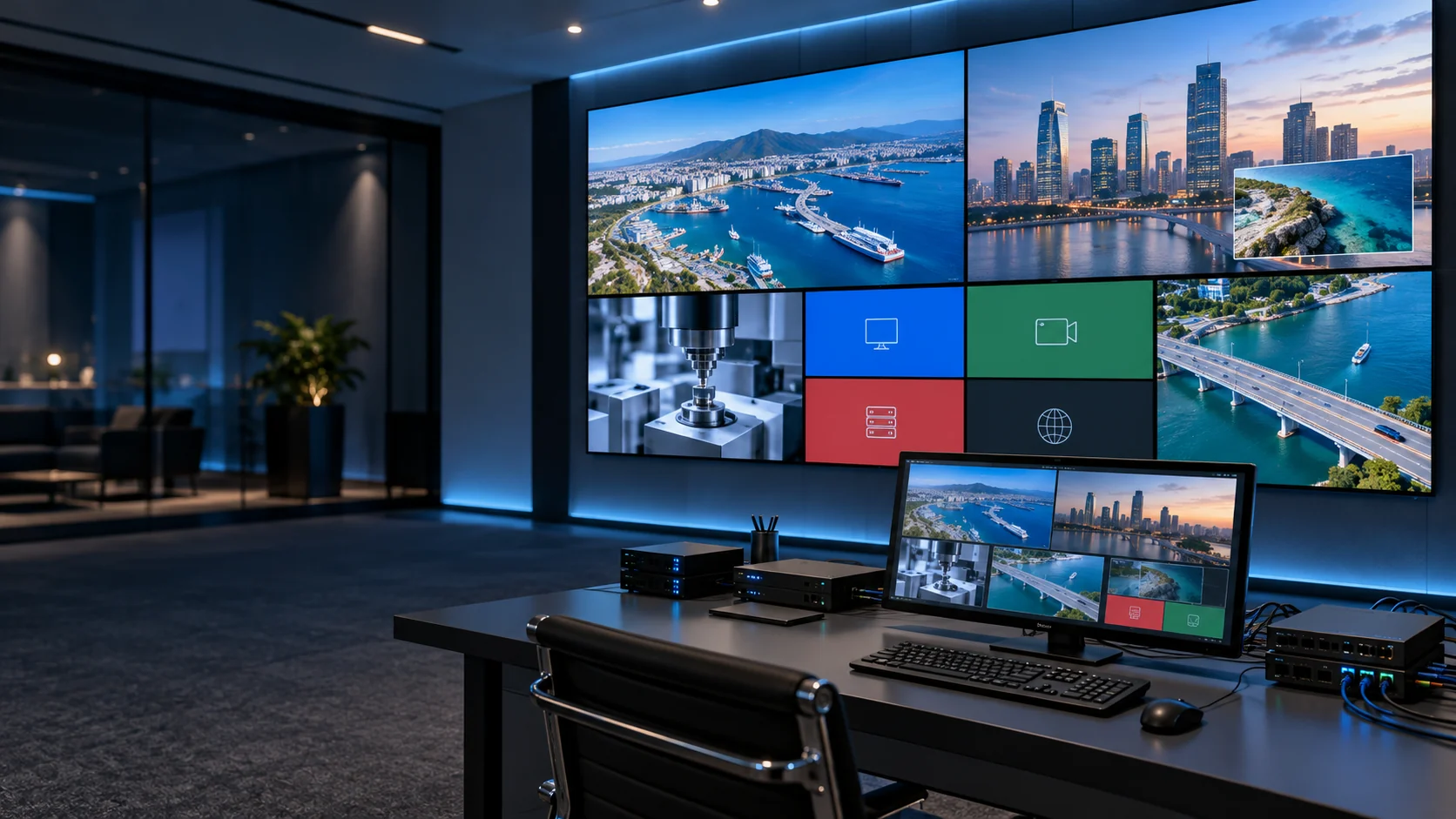
Light compression preserves desktop text, graphics and moving-video detail for professional displays, live monitoring and applications that need responsive interaction.
Reduce the bandwidth needed for high-resolution video. Unicast and multicast connections can be planned around stream counts, media bitrates and display requirements.
Combine codecs, windows, scaling, OSD, audio and USB into a media system that supports video transport, screen composition and remote operation.
Core boards, firmware, control interfaces and integration support can be adapted to customer interfaces, business software and product designs.
Combine sources in one output and configure window position, size and stacking for monitoring and operator workspaces. A typical JPEG 2000 configuration supports up to 8 windows; layouts and decoder combinations are configuration-specific.
Select a region of interest, scale it to a target window and adjust its position across a display layout. Receiver nodes and display control support flexible video walls and multiscreen presentations.
Overlay text, identifiers, graphics and application information for source labels, operator prompts and customer interfaces.
View low-resolution preview video from encoder HDMI inputs at the management workstation, using H.264 / H.265 transport for centralized source monitoring.
Combine video viewing with USB pass-through and keyboard/mouse support for operator extension and interactive terminals. Supported device types, pairing and control workflows depend on product configuration.
Configure separate audio and video paths where displays and audio playback equipment are deployed independently, with HDMI audio and local audio interfaces.
EDID management, multiscreen synchronization and source switching work with upper-layer software for signal selection, layout management and device control.
JPEG 2000 / JPEG XS light compression prioritizes low latency and high image quality for the main real-time video path. Typical low-bitrate H.264 / H.265 delivery configurations focus on bandwidth efficiency, often requiring more encoding, decoding and buffering delay. At aggressive compression settings, fine text, graphic edges and motion detail are also more easily lost.
Systems can combine both paths for responsive desktops, real-time video and other media services. H.264 / H.265 can also reduce the bandwidth needed for management workstation previews.
The FPGA handles JPEG 2000 / JPEG XS and real-time display processing for high-quality video transport and window composition.
An external SoC or supporting platform handles the relevant H.264 / H.265 processing and application functions. Decoded video from this path joins windows, picture in picture and composition through system interfaces.
| Codec configuration | Characteristics and selection |
|---|---|
| JPEG 2000 | For high-quality video transport and multiwindow display, balancing network bandwidth and integrated video-processing features. |
| JPEG XS | For low-latency real-time media, integrated with network transport, display processing and interactive functions. |
A typical JPEG 2000 configuration compresses one 4K60 stream to 470 Mbps, with 8.5 ms end-to-end latency and visually lossless 4:4:4 image quality. At the corresponding bitrates and network configuration, one Gigabit link can carry two independent 4K60 streams.
JPEG XS is configured for video format, latency, bitrate and FPGA resources. Its system performance is specified separately from JPEG 2000. Select the codec for the target network and display requirements.
Explore the JPEG 2000 IP and JPEG XS IP. For discovery and connection management based on open standards, see the IPMX solution and choose an integration path for your product.
The solution uses a KU5P FPGA platform with an external SoC for real-time media processing and application control.
In-house codec, transport and display modules can be optimized together at system level. Coordinated data paths, buffers, DDR access and processing schedules reduce duplicated logic and unnecessary data movement, leaving integration room for customer functions.
| Item | Configuration |
|---|---|
| HDMI input / output | HDMI 2.0, up to 4096×2160 @ 60 fps |
| Video encoding | One 4096×2160 @ 60 fps stream, or one 1080p60 stream |
| Video decoding | Two 4096×2160 @ 60 fps streams, or eight 1080p60 streams |
| Typical media bitrate | One 4K60 stream: 470 Mbps |
| End-to-end latency | 8.5 ms |
| Colour formats | RGB, YCbCr 4:4:4, YCbCr 4:2:2 |
| Bit depth | 8 / 10 / 12 bit, according to video format and configuration |
| Compression ratio | 1:1–27:1, according to application configuration |
These are JPEG 2000 configuration references. Available combinations of concurrent decoding, window layout, colour format, bit depth and bitrate depend on configuration. JPEG XS parameters are provided for the selected configuration.
| Item | Function |
|---|---|
| Multiwindow | Up to 8 windows with the JPEG 2000 configuration |
| Crop and scale | Video-region cropping and window resizing |
| Screen composition | Picture in picture, stacking, window positioning and video roaming |
| OSD | Text, graphics and application information overlays |
| Display coordination | Multiscreen synchronization; black-frame-free switching with the corresponding JPEG 2000 configuration |
| Audio/video routing | Independent audio and video transport |
| USB | USB pass-through and keyboard/mouse integration |
| Management preview | Low-resolution preview video from HDMI inputs, transported using H.264 / H.265 compression |
| System management | EDID management and control-interface support |
| Item | Interface and configuration |
|---|---|
| Video | HDMI 2.0 input / output, configured for Sender and Receiver roles |
| Audio | HDMI embedded audio and I²S digital audio; analog audio uses supporting audio devices |
| Audio sample rate | 48 kHz, according to audio configuration |
| USB | USB 2.0 Host ×2, Device ×2, used according to role and board configuration |
| Network interfaces | RGMII ×2, 10GBASE-R ×1; external port types depend on the core board and carrier |
| Network transport | UDP / IP, unicast / multicast |
| Debug and control | Mini USB debug / serial interface and supporting control interfaces |
Interfaces, throughput and feature combinations depend on the core board, firmware and codec configuration and can be adapted to product requirements.
Suitable for professional displays and video walls, collaboration rooms, control rooms, live monitoring and interactive operator workstations, with flexibility for customer product designs and application functions.
Share your video formats, network bandwidth, latency, window layouts and interaction requirements. BergLogic can advise on codecs, core boards and system integration.
Discuss your integration